



Sedona Hotel vs. Vacation Rental: Costs and Booking Checklist
- October 13, 2026
- Arizona Guides
Compare Sedona hotels and vacation rentals using the full price, sleeping arrangements, location, parking and cancellation terms before booking. Read More
 by HVA Team
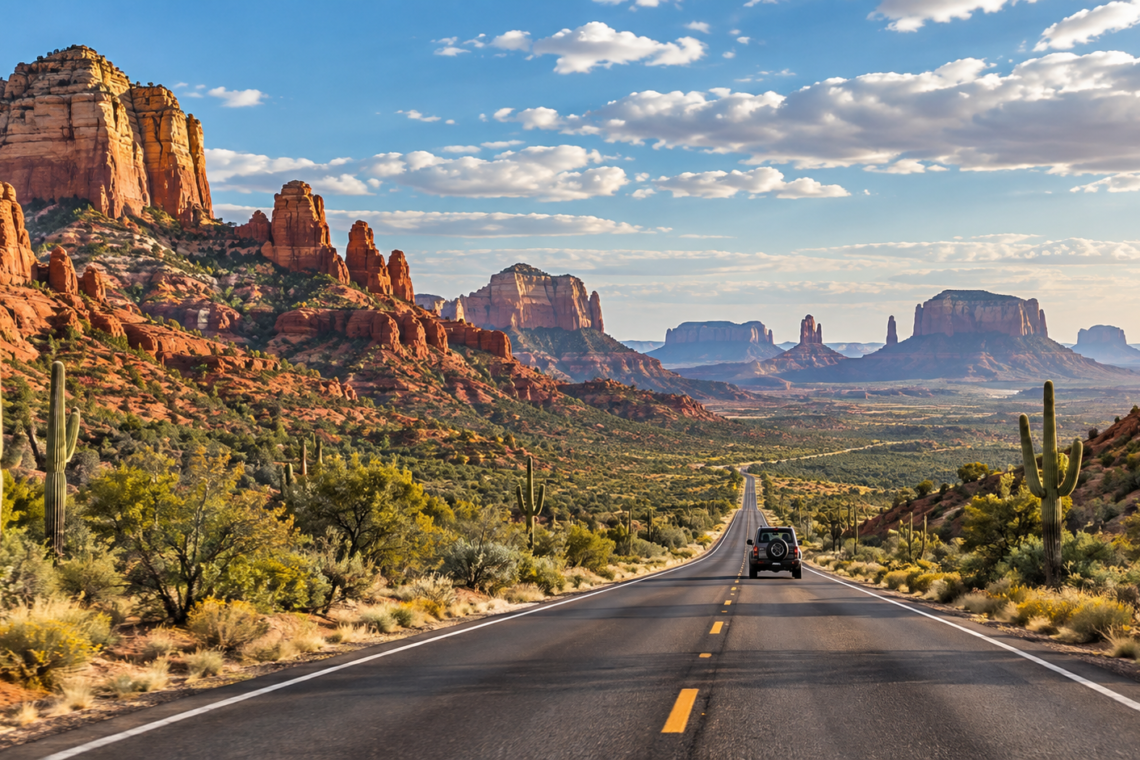
Arizona rewards travelers who leave enough room in the itinerary for the road itself.
A drive that begins among Phoenix’s saguaros can end a few hours later beneath Sedona’s red cliffs or Flagstaff’s ponderosa pines. Continue north and the landscape opens into the Grand Canyon, Lake Powell and Monument Valley. Turn west and historic Route 66 leads through towns that still preserve the architecture and roadside culture of America’s most famous highway.
That variety is what makes an Arizona road trip different from a vacation built around one destination. The distance between places is often manageable, but the changes in elevation, temperature, scenery and terrain can be dramatic.
This guide brings the state’s strongest road-trip routes into one place, with practical advice on how long to allow, what deserves an overnight stay, what to prepare before leaving and where HVA’s more detailed guides can help you plan the next part of the trip.
A rental car is often the most practical way to travel between Arizona destinations, especially when the itinerary includes national parks, scenic highways, and stops outside major cities. Travelers arriving in Phoenix can compare rental cars with other transportation options before deciding how to get around.
Arizona road trips can include long highway stretches where fuel, shade and roadside assistance are not immediately available. Summer adds extreme heat, while the monsoon season can produce sudden rain, flash flooding, strong winds and dust storms.
The Arizona Department of Transportation recommends checking the vehicle before a road trip, carrying extra drinking water, keeping a charged phone and charger available, checking tire pressure and fluid levels, and consulting AZ511 for current road and weather conditions. During extreme heat, ADOT also recommends maintaining plenty of fuel because being stranded without fuel can become dangerous quickly.
Three items are particularly useful because they solve problems that otherwise leave you dependent on another vehicle or a roadside-assistance truck.
A dead battery is inconvenient in a parking lot and much more serious on an isolated Arizona highway.
The NOCO Boost GB40 1000A is compact enough to keep in the vehicle and can jump-start compatible 12V batteries without needing another car. Car and Driver’s 2026 testing named the GB40 its most compact portable jump starter, while ADOT specifically warns that Arizona heat can weaken automotive batteries.
Check the NOCO Boost GB40 on Amazon →
Arizona’s heat and long highway stretches make tire pressure worth checking before departure. ADOT warns that improperly inflated tires combined with hot pavement increase the risk of tire failure.
The VIAIR 88P Portable Compressor can inflate tires up to 33 inches and includes an integrated pressure gauge. It is particularly useful for travelers covering long distances or driving between destinations where finding an air pump may be inconvenient.
Check the VIAIR 88P Portable Compressor on Amazon →
Navigation, hotel confirmations, attraction tickets, weather alerts and emergency calls all depend on the phone staying charged.
The Anker 535 67W 3-Port Car Charger provides two USB-C ports plus USB-A, allowing several devices to charge from one vehicle outlet.
Check the Anker 535 67W Car Charger on Amazon →
You can enjoy a single Arizona scenic route in one day, but a statewide trip deserves considerably more time.
Visit Arizona’s own statewide road-trip itinerary covers roughly 1,500 miles and recommends at least 14 days for a broad loop beginning and ending in Phoenix.
For most travelers:
| Time available | Good approach |
|---|---|
| 1 day | Choose one route near Phoenix |
| 2–3 days | Sedona + Flagstaff or Lake Havasu |
| 4–5 days | Sedona + Flagstaff + Grand Canyon |
| 5–7 days | Add Page/Antelope Canyon |
| 7–10 days | Add Monument Valley or Route 66 |
| 10–14 days | Build a larger northern + southern Arizona loop |
Trying to see every major Arizona destination in four days usually means spending much of the trip looking through a windshield. Choose fewer places and give the important stops enough time.
Approximate direct distance: 113 miles
Direct driving time: about 2 hours
Best for: first-time Arizona visitors, red-rock scenery, hiking and weekend trips
Phoenix to Sedona is one of the easiest road trips to recommend because the drive produces a dramatic change in landscape without requiring an entire day behind the wheel.
The direct route follows Interstate 17 north before turning onto State Route 179 toward Sedona. The Sedona Chamber lists the drive at approximately 113.4 miles and two hours under normal conditions.
State Route 179 is part of the attraction. Visit Arizona identifies the Red Rock Scenic Byway as a 14.5-mile scenic road passing Bell Rock, Courthouse Butte, Village of Oak Creek and the red-rock formations surrounding Sedona.
Allow more than the navigation estimate if you plan to stop.
Sedona deserves at least one full day if hiking, sightseeing or taking a tour is part of the plan. Two nights provide a much more relaxed experience.
Travelers coming from Phoenix can drive to Sedona independently or join a guided tour, depending on their transportation preferences, schedule, and planned activities.
October visitors should prepare for warm afternoons and cooler mornings and evenings. Packing appropriate clothing and hiking essentials can make outdoor activities more comfortable.
An overnight stay allows you to enjoy the area after day visitors leave and gives you the following morning for another hike, scenic drive or breakfast before continuing north.
If Sedona is an overnight stop, compare hotel and vacation rental costs before booking. Cleaning fees, parking charges, and the length of your stay can change which option offers better value.
Check Sedona hotels for your road-trip dates →
Approximate driving time without stops: about 1 hour
Best for: scenic driving, fall color, forest scenery and travelers continuing north
Do not automatically follow the fastest navigation option between Sedona and Flagstaff.
State Route 89A through Oak Creek Canyon is one of Arizona’s standout scenic drives. The road climbs from the red-rock environment around Sedona through the canyon and eventually into the high-country forests near Flagstaff.
Discover Flagstaff notes that a direct trip takes about an hour without stops, but recommends allowing a half-day or more if you want to enjoy Oak Creek Canyon. The climb gains several thousand feet of elevation before reaching Flagstaff.
The route is particularly attractive in autumn when the canyon foliage changes color.
Flagstaff is worth staying overnight rather than treating it only as a waypoint. Downtown, Route 66 history, nearby trails, Arizona Snowbowl and the surrounding ponderosa forest give it a character completely different from Phoenix or Sedona.
Fall brings changing foliage to Flagstaff, particularly in areas with aspen trees at higher elevations. The best places to see Flagstaff’s fall colors depend on elevation, weather conditions, and the timing of the seasonal color change.
Check Flagstaff hotels for your travel dates →
Approximate distance: 80 miles
Driving time: roughly 1½ hours
Best for: first-time Arizona trips, families, photographers and national-park visitors
Flagstaff is one of the most convenient bases for approaching the South Rim.
Visit Arizona recommends the route through Highway 180 and Highway 64, which passes through Kaibab National Forest on the way toward Grand Canyon National Park.
The biggest planning mistake is assuming that reaching the rim means you have seen the Grand Canyon.
Give yourself enough time to walk sections of the Rim Trail, stop at more than one viewpoint and experience how the landscape changes as the light moves across it.
If the trip allows only one Grand Canyon day, arrive early.
If the canyon is one of the primary reasons for visiting Arizona, stay overnight near the South Rim rather than adding several hours of driving to an already full sightseeing day.
HVA has a detailed comparison of shorter and longer South Rim helicopter flights.
See whether a Grand Canyon helicopter tour is worth it before choosing your flight.
Approximate driving time: around 2½ hours depending on route and conditions
Best for: slot canyons, photography, guided experiences and dramatic desert scenery
Page is one of the strongest additions to a northern Arizona road trip because several major attractions sit within a relatively compact area.
Travelers come primarily for:
Antelope Canyon requires guided access, so this is one part of an Arizona road trip that should not be left entirely to spontaneity.
If you are trying to decide which canyon to visit, HVA already has the comparison:
Read Upper vs. Lower Antelope Canyon: Which Tour Should You Book?
That guide also covers a combined Upper and Lower Canyon tour and an itinerary that adds Horseshoe Bend.
Page works much better when you do not try to squeeze Antelope Canyon, Horseshoe Bend and another long drive into the same day.
Check Page hotel availability for your road-trip dates →
Best for: landscape photography, Navajo culture and iconic Western scenery
The road toward Monument Valley takes you deeper into the landscapes that define the American Southwest.
Arizona’s official scenic-road inventory identifies US 163 through the Kayenta–Monument Valley corridor as a designated scenic road, while Monument Valley Navajo Tribal Park allows visitors to explore its famous mesas and buttes within Navajo Nation lands.
The tribal park includes a 17-mile dirt scenic loop, where conditions can differ considerably from ordinary paved-road travel. Check current Navajo Nation rules and road conditions before entering rather than assuming a rental car or low-clearance vehicle is suitable under every condition.
Monument Valley is not simply another roadside overlook. The landscape has deep cultural significance, and visitors should follow Navajo Nation regulations and respect areas where access is restricted.
Long Arizona drives produce plenty of scenery worth recording, but a dash cam also serves a practical purpose by continuously documenting the road.
The VIOFO A229 Pro records 4K video from the front and 2K from the rear in its two-channel configuration, using Sony STARVIS 2 sensors. Car and Driver’s current road-trip gear recommendations include a reliable dash cam among useful long-distance driving equipment.
For HVA readers who already enjoy recording scenic drives, this is one road-trip purchase that has value after the vacation ends.
Check the VIOFO A229 Pro on Amazon →
Best for: history, roadside Americana, classic cars and travelers who enjoy the drive as much as the destination
This route deserves special attention in 2026, the centennial year of Route 66.
Arizona contains 385.2 miles of historic Route 66, which Visit Arizona describes as the longest preserved stretch of the original Mother Road in the United States.
That creates an unusual opportunity this year: travelers can experience Route 66 during its 100th anniversary while towns throughout Arizona celebrate the highway’s history.
Strong stops include:
ADOT’s scenic-road inventory identifies a 152-mile Historic Route 66 All-American Road section from Topock to Ash Fork, including Oatman, Kingman and Grand Canyon Caverns.
This is not a route to rush.
Old motels, neon signs, diners, trading posts, museums and stretches of historic pavement are the reason to take Route 66 instead of remaining on Interstate 40.
If you’re creating a multi-day Arizona road trip in 2026, Route 66 deserves serious consideration rather than being treated as a quick photo stop.
Best for: geology, national parks, Route 66 history and travelers continuing east
Petrified Forest National Park fits naturally into an eastern Arizona Route 66 trip.
The park’s main road runs approximately 28 miles from one end to the other. The National Park Service notes that driving straight through takes roughly an hour, although that leaves little time for trails, overlooks, museums or the colorful badlands of Blue Mesa.
The northern portion emphasizes Painted Desert vistas and human history, while the southern end contains some of the park’s highest concentrations of petrified wood.
Give it several hours rather than driving through solely to say you visited.
This section is also a reminder of why keeping fuel, water and vehicle essentials under control matters. Eastern Arizona can involve longer distances between services than many visitors expect.
Best for: weekend trips, water activities, desert scenery and winter/spring travel
Arizona’s road-trip identity is not limited to red rocks and mountain forests.
Travel west from Phoenix and the landscape eventually meets the Colorado River at Lake Havasu City, creating a combination of desert and waterfront recreation that feels completely different from northern Arizona.
A Lake Havasu weekend can include:
A traditional cooler works perfectly well for many trips, but travelers who take frequent road trips may appreciate not dealing with bags of melting ice.
The BougeRV 23-quart 12V portable refrigerator can run from vehicle power and uses compressor cooling. A product like this becomes more useful on multi-day trips, camping weekends or drives where you want cold drinks and food available without repeatedly buying ice.
Check the BougeRV 23QT Portable Car Refrigerator on Amazon →

Northern Arizona receives much of the road-trip attention, but southern Arizona deserves its own itinerary.
Phoenix to Tucson takes roughly two hours under normal conditions, and Tucson provides access to Saguaro National Park, Mount Lemmon, the Arizona-Sonora Desert Museum and a strong regional food scene.
Visit Arizona recommends southern Arizona primarily from October through April, when temperatures are generally more comfortable for outdoor activities.
A longer southern loop can continue toward Bisbee, Tombstone, Sonoita and Sierra Vista.
This makes a strong alternative for winter visitors when parts of northern Arizona are dealing with snow, seasonal road restrictions and colder temperatures.
There is no single statewide answer because Arizona’s elevation changes create dramatically different climates.
Best for:
Generally stronger for:
Visit Arizona uses those broad seasonal patterns in its current planning guidance.
Spring and fall are particularly useful when your itinerary combines both desert and high-country destinations.
Summer road trips remain possible, but desert temperatures can exceed 100°F. ADOT warns drivers to prepare both themselves and their vehicles for extreme heat.
Arizona’s monsoon period brings thunderstorms, heavy rain, strong wind, flash flooding and dust storms.
If you see a dust storm ahead, do not drive into it. ADOT advises drivers to exit the highway and wait when possible. If caught in low or zero visibility and unable to exit, pull completely off the roadway as far as safely possible, set the parking brake, switch off vehicle lights and keep your foot off the brake so other drivers do not mistake your lights for a lane to follow.
Never drive into a flooded wash or around a road-closed sign.
Before leaving each day, check:
AZ511 → road conditions → closures → weather → fuel → water → phone charge.
That takes minutes and can prevent hours of trouble.
You do not need to fill the vehicle with emergency gadgets, but a few basics belong in the car:
These recommendations closely match ADOT’s current road-trip and extreme-heat guidance.
For a first visit, this route provides strong variety without attempting to cover the entire state:
Day 1: Phoenix → Sedona
Take SR-179 into red-rock country and stay overnight.
Day 2: Sedona
Hike, explore scenic viewpoints or take a guided tour.
Day 3: Sedona → Oak Creek Canyon → Flagstaff
Drive 89A and stay in Flagstaff.
Day 4: Flagstaff → Grand Canyon South Rim
Spend the day at the canyon and stay near the park or return to Flagstaff.
Day 5: Grand Canyon → Page
Continue toward Horseshoe Bend and stay in Page.
Day 6: Antelope Canyon + Lake Powell/Page
Reserve Antelope Canyon in advance.
Day 7: Return toward Phoenix or extend to Monument Valley
Seven days gives you a substantial northern Arizona trip without turning every day into a long-distance driving exercise.
For a longer trip, add Monument Valley, Route 66, Lake Havasu or southern Arizona rather than squeezing those destinations into the same week.
Choose Phoenix to Sedona for an easy introduction to Arizona’s red-rock landscapes.
Choose Sedona to Flagstaff through Oak Creek Canyon when the drive itself matters.
Choose Flagstaff to Grand Canyon for Arizona’s defining national-park experience.
Choose Page and Monument Valley for slot canyons and expansive desert scenery.
Choose Route 66 for history, roadside culture and a trip built around the highway itself.
Choose Lake Havasu when water, desert recreation and a weekend pace sound more appealing.
Choose Tucson and southern Arizona during the cooler months for saguaros, mountain drives and a different side of the state.
The strongest Arizona road trip rarely comes from seeing the largest number of places. It comes from choosing a route where the scenery, stops and overnight destinations fit together naturally, then allowing enough time to enjoy them.
Before each driving day, check road conditions, weather and your vehicle. Carry more water than you think you need. Leave room in the itinerary for a viewpoint, town or stretch of road you did not expect to be the highlight.
That is where Arizona road trips tend to become memorable.

Compare Sedona hotels and vacation rentals using the full price, sleeping arrangements, location, parking and cancellation terms before booking. Read More

Staying near 85037, Westgate or State Farm Stadium? Use this quick guide to find nearby food, groceries, pharmacies, shopping, entertainment, fuel, car... Read More
Compare Uptown, West Sedona, the Village of Oak Creek and Oak Creek Canyon to choose a base that fits your first Sedona... Read More
Compare 30-, 60- and 90-night commitments,... Read More

Compare furnished houses and hotels for... Read More
Plan data center contractor housing in... Read More

Choose contractor housing near the right... Read More

Compare furnished housing near TSMC Phoenix... Read More

Compare Sedona hotels and vacation rentals... Read More
HighVoltageArea may earn a commission when you book or purchase through our links. Learn more