This article contains affiliate links. A commission may be earned when you book through these links.
A Cactus League map becomes useful when you put your actual games on it. Ten ballparks do not create ten equally convenient journeys from a hotel labeled “Phoenix.” Mark the games you are most likely to attend, group them by location and compare the total travel from two or three accommodation options before booking.
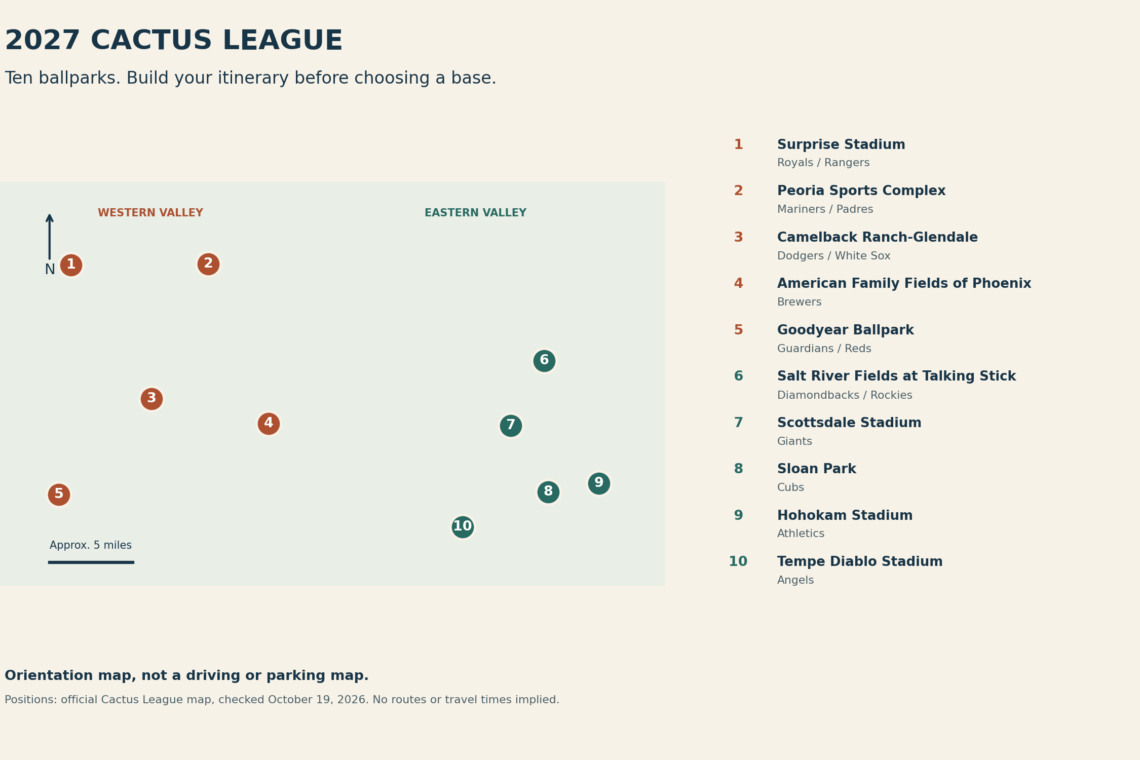
The official Cactus League stadium map provides venue links and directions. Use it for navigation and current stadium details. The numbered orientation map accompanying this article shows relative ballpark positions, not driving routes, lot entrances or guaranteed travel times.
Find the ten ballparks
The numbers below match the orientation map. These practical clusters are a way to organize a trip, not official league divisions or promises that every pair is a quick drive.
| Map number |
Ballpark |
Home club or clubs |
Planning cluster |
| 1 |
Surprise Stadium |
Royals, Rangers |
Northwest |
| 2 |
Peoria Sports Complex |
Mariners, Padres |
Northwest |
| 3 |
Camelback Ranch-Glendale |
Dodgers, White Sox |
Western |
| 4 |
American Family Fields of Phoenix |
Brewers |
Western |
| 5 |
Goodyear Ballpark |
Guardians, Reds |
Southwest |
| 6 |
Salt River Fields at Talking Stick |
Diamondbacks, Rockies |
Northeast |
| 7 |
Scottsdale Stadium |
Giants |
Scottsdale |
| 8 |
Sloan Park |
Cubs |
Mesa |
| 9 |
Hohokam Stadium |
Athletics |
Mesa |
| 10 |
Tempe Diablo Stadium |
Angels |
Tempe |
Do not substitute a home club’s training base for the venue on your ticket. A team’s away game may be closer to your accommodation than its home park. Shared facilities and split-squad listings also make it important to record the venue beside the team name.
For neighborhood descriptions and housing formats, use the spring-training accommodation overview. The decision here is narrower: how to turn a list of games into a workable base and travel plan.
What the 2027 schedule can tell you now
The official 2027 league schedule, checked October 19, 2026, begins February 19. Many first-pitch times remain TBD. Announced dates help you choose a travel window, but do not yet establish whether two games fit into the same day.
An official schedule link labeled “Tickets” does not by itself prove that every game is already on sale. Follow the venue’s current offer and verify the game, seat, fees and ticket delivery before paying. Match lodging cancellation deadlines to the uncertainty you are accepting, rather than assuming a game change will automatically refund a hotel.
Build a game list before opening hotel results
Make a short list with five pieces of information for each game: date, venue, opponent, confirmed or unconfirmed start time, and importance to the trip. Give must-see games more influence than games you might add if convenient.
Then mark the repeated journeys. Four games in Surprise and Peoria suggest a different search from four in Mesa and Scottsdale, even if each trip includes one outing on the opposite side of the Valley.
| Your game pattern |
Bases worth comparing first |
What could change the choice |
| Mostly Surprise and Peoria |
Surprise, Peoria or nearby northwest Valley |
A must-see game elsewhere or a recurring non-baseball destination |
| Mostly Camelback Ranch and Goodyear |
West Phoenix, Glendale, Avondale or Goodyear |
The exact mix of venues and property access |
| Mostly Sloan, Hohokam and Tempe Diablo |
Mesa or Tempe |
Several Scottsdale games or a stronger non-baseball priority |
| Mostly Scottsdale Stadium and Salt River Fields |
Scottsdale-area options mapped to the actual parks |
North versus south location, daily transport and other games |
| A genuinely even east/west split |
Two well-placed bases versus one compromise base |
Stay length, moving cost and extra lodging fees |
These are search areas, not hotel rankings. Check each property’s location against the route you will use. A large city label can hide a substantial difference between two addresses.
Compare total journeys, not the nearest stadium
For each serious accommodation option, estimate the round trip to every planned game at a similar day and time. Add those estimates. Count repeat visits separately. Treat live map estimates as planning inputs, not guarantees for a future event day.
A six-game example
Suppose you plan four western games and two eastern games. In this hypothetical comparison, Base A requires 40 minutes of round-trip road travel for each western game and 100 for each eastern game. Base B requires 90 and 35 minutes respectively.
| Option |
Western games |
Eastern games |
Total estimated road time |
| Base A |
4 × 40 = 160 minutes |
2 × 100 = 200 minutes |
360 minutes |
| Base B |
4 × 90 = 360 minutes |
2 × 35 = 70 minutes |
430 minutes |
Base A saves 70 minutes across the six games under those assumptions. Whether that is worth a higher room price depends on your actual quotes and priorities. These are invented inputs, not measured Phoenix drive times. Neither total includes stadium queues, parking walks or security.
If some games are optional, run the comparison twice: once with all games and once with just the must-see list. A hotel that wins only because of three games you are unlikely to attend may be the wrong commitment.
When does splitting the stay make sense?
A split stay deserves consideration when the games fall into consecutive western and eastern blocks and the trip is long enough to absorb a move. It is less attractive when games alternate sides every day or the party needs continuity for children, mobility, pets or remote work.
Compare the saving with the cost of changing accommodation. For example, saving $30 per night for four nights produces $120. An extra $95 cleaning charge and $40 of moving transport cost $135, wiping out the saving before you value the time spent packing. These are hypothetical amounts; use actual final quotes.
Check checkout and check-in times, where bags will go during the gap, and whether the moving day already includes a game. Two convenient hotel locations can still create an inconvenient transfer day. Do not assume either property offers luggage storage or early access.
When comparing accommodation on Booking.com, search each destination with the exact nights and party size. Compare one continuous stay with the two separate stays, including mandatory charges and parking, rather than adding together headline nightly rates.
Can you attend two games in one day?
Only make that commitment after both start times are confirmed and the travel gap works for your party. Use this sequence:
Expected time leaving your seat + walk and lot exit + road journey + second-park parking, walk and screening = earliest realistic arrival at the next seat.
The first game’s ending time remains uncertain. If a hypothetical game ends at 4:15 p.m., 25 minutes to exit, 40 minutes driving and 30 minutes entering the next park put you at your next seat at 5:50 p.m. A 6:05 p.m. first pitch leaves only 15 minutes of margin. Those are planning assumptions, not 2027 start times or measured routes.
Decide in advance whether you are willing to leave the first game early. If not, and the second ticket is expensive or restrictive, one game can be the better plan. A same-side pairing still needs a route check; proximity on a small map does not include an event-day queue.
A rental car, rideshare or transit?
For a group attending multiple parks, compare the complete vehicle cost with the required rides. Include accommodation parking, stadium parking for each venue, fuel and any second vehicle. Do not extend one park’s free-parking policy to the whole league.
For rideshare, count each leg and the vehicle size needed, including the return after a crowd leaves. For transit, check the actual trip in the operator’s planner, the final walk and the return service. Do not assume a rail stop serves a ballpark simply because it serves part of the same city.
The Phoenix car-versus-transit comparison covers the broader choice. Use AZ 511 for current road conditions and closures before traveling between parks.
Keep the two stadium-specific checks separate
The Surprise Stadium 2027 guide covers its ticket announcement, parking approach and policy issues. The Camelback Ranch 2027 guide addresses its venue identity, western lodging choices and day-of planning.
For every other park, open its official details from the league map before packing. Record the bag rule, water allowance, entry instructions and ticket access method. Repacking one small game-day kit between venues is easier than discovering at security that yesterday’s permitted item is not accepted today.
Questions visitors ask
Is there one central hotel area for all ten stadiums?
There is no base that minimizes every journey. Compare the total travel for your specific games, then add the non-baseball trips you will repeat. “Central” is useful only in relation to those destinations.
Should I stay near the airport?
An airport-area stay can fit arrival, departure or other priorities. Evaluate the repeated game-day journeys before choosing it for an entire baseball trip. One airport transfer should not automatically outweigh six stadium outings.
Is the map a driving-time map?
No. It shows ballpark positions using published league coordinates. Follow the official venue directions and current navigation for road routing, entrances and parking. Use the numbered key to organize the itinerary, then test real routes.
Before booking, you should be able to identify your must-see games, the base that works for them, your complete lodging and transport totals, and the changes your reservations permit. That is a more reliable starting point than selecting the cheapest room anywhere labeled Phoenix.

 by